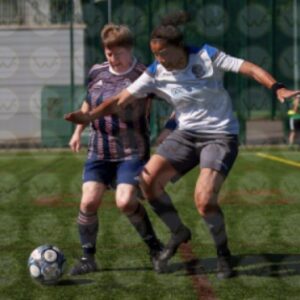
Football might not have come home this year, but Parkinson’s United Walking Soccer has a new home here in Toronto.
The Parkinson’s United Walking Soccer Festival was at Cherry Beach Sports Fields last week and welcomed teams from England to kick off Parkinson’s United, the Toronto Walking Soccer Club’s new division for people living with Parkinson’s.
Walking soccer (or football) is hugely popular in the United Kingdom, and the Toronto Walking Soccer Club (TWSC) was established in 2023 and is rising in popularity. It follows the standard rules of soccer, except at a slower, more intentional pace.
Four years ago in the United Kingdom, a men’s squad for those with Parkinson’s was established, and the women’s side started last year. Now, TWSC is joining the movement.
Parkinson’s is a progressive neurological disorder that causes tremors, trouble walking, and more. It affects more than 120,000 Canadians. Exercise is one of the most powerful treatments that slows down progression, improves motor skills and cognition, and creates community.
Before coming down to Cherry Beach on Thursday, Sept. 17, Team England played games in the Canada International Walking Soccer Festival with Women’s 50s, Men’s Parkinson’s, Men’s 60s, Women’s 60s, Men’s 70s, and Women’s Kicking Cancer.

- Walking Football design featuring the slogan ‘Still Got It – Just At Walking Speed’. Made for over-50s players, veterans, teammates, team captains & five-a-side regulars who’ve got the skill, energy & love of the game, whatever their pace on the pitch.

Last update on 2026-10-15 / Affiliate links / Images from Amazon Product Advertising API. Walking Football Limited is also an Amazon Associate and earns a commission from qualifying purchases
Kerrin Hands founded TWSC and co-founded Parkinson’s United. He said founding the league, alongside Aidan Butterworth, will introduce walking soccer to a whole new demographic of players.
“We’ve grown from people playing in the park to 240 members. Parkinson’s United is something that we’ve developed for the Parkinson’s community, and we’re just in our first few weeks. When the England teams were coming over, we got together and decided we would hold a festival, hopefully to catch people’s imaginations and inspire them to come out and try this sport,” he said.
“Soccer has been unique because in Canada, there aren’t many or any team sports for people with Parkinson’s; this is the first one.”
Last Thursday’s event started with warm-up and drills led by England management and players. Then, new walking soccer players were mixed in with English players for scrimmages. After that, there was exhibition game action with the established teams.
Parkinson’s United Walking Soccer Festival

Gemma Darvill is the coach and manager of the England Parkinson’s Women’s National Team that was put together last year after the success of the men’s side. Her father was diagnosed with Parkinson’s eight years ago, and she was at a tournament in St. George’s Park (English Football Association’s national football centre in Staffordshire) with him when she was approached by another woman who asked if she would run a women’s team.
“So we started with a women’s team in Birmingham; we’ve got ladies from Manchester, Devon, all over. Once a month we trained. From there, we’ve built an England squad. It’s the first all-female Parkinson’s England team,” she said.
“For some people, it’s really saved their lives. My dad was one of them,” said Darvill about the impact walking soccer has on those with Parkinson’s.
“The benefits are fantastic. Not only the physical well-being but the mental as well. It’s a social connection. They then get to talk about their symptoms and any struggles they’re having and just be there for each other.”
Jo Eastough is also part of England’s women’s team as the physiotherapist. She has been working with people with Parkinson’s for more than 16 years and became involved in walking football about four years ago. She started by supporting a team at the local level, and then was asked if she would like to be the physiotherapist for the national team.
“Of course I jumped at the chance. My role is twofold. I can provide that pitch-side support for injuries, but because I’ve got a knowledge of Parkinson’s and a medical head on me, I can support the players more holistically,” she said.
Parkinson’s has more than 40 different documented symptoms, and Eastough’s role is to be able to help players with whatever their needs are because it’s so variable. After leaving the National Health Service (NHS) to work with walking football, she said it’s been incredible to be moving forward with the women’s team and coming to Toronto.
“Never in a million years did I think I would be travelling the world with this team, supporting people at a local level and nationally,” she said.
“Physiotherapy and exercise have such big benefits for people with Parkinson’s. We say exercise is medicine and it’s the only proven modality that has a potential to slow the progression of Parkinson’s, so you could have a massive impact on someone’s life as a physio, and that’s incredibly rewarding…These players, what they go through day to day, they completely inspire me, and they’ve become friends and this wonderful football family. To be able to be with and come to Canada and network and support local people and spread that awareness and give people hope, and inspire them, well that means the world to me,” said Eastough.
Another person in the health field at last Thursday’s sessions was Nicole Anderson, a senior neuroscientist at Baycrest in North York. She studies cognitive aging and forms of neurodegeneration and became a TWSC member this year.
“I’m excited about this because there’s a lot of anecdotal evidence that walking soccer eliminates or at least alleviates the symptoms of Parkinson’s. You’ll see somebody who is stiff or has a tremor, but once they have the ball at their feet, all of that goes away, and nobody knows why,” she said. “So as a scientist, my goal is to support this quality-of-life benefit and the exercise benefit but also to one day answer that question as to why those symptoms go away.”
Anderson uses mobile neuroimaging technologies, where people wear a cap on their head that tracks how brain networks change while they’re playing. She thought Parkinson’s United was a fabulous idea as it combines two of her passions: soccer and neuroscience.

TWSC and England were in charge of the on-the-pitch action at Cherry Beach fields last Thursday, and TWSC teamed up with Passion for Parkinson’s Foundation to make the day happen. The foundation sources, implements, and funds creative arts and exercise programs for people living with Parkinson’s.
Founding director Tamara Boaden said walking soccer has been the biggest hit that she has seen in a while. Her husband had Parkinson’s, and most of those who are part of the volunteer organization also have a connection. She said seeing everyone out at the walking soccer event was emotional for her.
“This is just special. To be here with the UK and Toronto Walking Soccer Club, Passion, all together it’s like one big happy family,” said Boaden.
Toronto player Rick Suvanto said he was all in when he heard about Parkinson’s United.
“The best part is that it incorporates everything I advocate for, which is exercise and social contact with people. People with Parkinson’s have to get out of the house and live because we tend to isolate ourselves, and this is a good way to get out,” said Suvanto. “Other things that we do, like biking or boxing, are very individual; this is a great one for team-building. You’re actually on a team supporting each other, and it gives you more of a commitment to show up knowing people are waiting for you.”
Suvanto said he never really played team sports growing up and is now having so much fun being part of one. He also runs a newly diagnosed support group for people with Parkinson’s and said it’s great to see others also joining a team for the first time.
Larry, another player, does a different sport every day of the week, and can often be seen on the pitch taking part in walking soccer.
“(The best part) is the social aspect. You’re with people who are going through the same thing you are, and everybody’s at different stages. It helps you feel comfortable with the disease; you know you’re not the only one going through it, and other people understand what’s going on,” he said.
The camaraderie is also important to Team England midfielder and forward Simon Forrest.
“In Parkinson’s, we found that in the first three or four years, we were the only ones, and that’s growing now. Seven or eight countries have got national teams, and we’re going to head towards a European Championship,” he told Beach Metro Community News. “To put on the England shirt for me, it’s a fantastic thing to do for me, but the main thing is to see people who’ve never done it; they’re going to learn, and we’re going to improve because of it.”
Later in an address to the crowd at Cherry Beach, Forrest said it was a real privilege to be there raising awareness about Parkinson’s and walking soccer.
“Parkinson’s hasn’t got a chance; you all are going to beat it. (It’s) a lonely, lonely condition to get. Make some new friends today as well,” he said.
Now that Parkinson’s United has been officially launched, sessions will take place on Tuesdays until Oct. 27 from 10 a.m. to 12 p.m. at Cherry Beach Sports Fields, at 275 Unwin Ave.
For more information on Parkinson’s United, please visit https://torontowalkingsoccer.com/
Related Posts

Southwell woman to represent Parkinson’s walking football team in Canada

Fundraiser Art Exhibition in aid of England Parkinson’s Women’s Walking Football team

World Cup may be over, but walking soccer is getting started in New York

Incredible talent on display at inaugural Canada Women’s Showcase Walking Soccer

Walking football allowing people of all ages, fitness levels and abilities to play the beloved game

Dorset Parky Striders close out another season in style

Author: The Walking Football
You create the memories; we help you relive them forever!