
Walking Football Guide Table of Contents
Introduction
Walking Football is one of the fastest-growing sports for adults over 50. It combines the joy of football with low-impact movement that delivers real physical, mental, and social benefits. This is achieved while keeping injury risk very low.
A cross-sectional survey of 352 players (mean age 56, broad 33-81 range, 55% men / 44% women) conducted at the 2024 England FA regional finals (published in 2025 frontiers in Sports and Active Living).
Perceived benefits (since starting walking football):
- Social connections: 82.6% reported improvments.
- Physical fitness: 78.0% reported improvements.
- Mental wellbeing 73.8% reported improvements.
Whether you want to play, start a session, or just understand the rules, this 2026 walking football guide covers everything – connecting you to thousands of of real clubs worldwide.
This study illustrates the diverse benefits that players experience through participation.
Section 1: What is Walking Football?

In the simplest terms, walking football is the beautiful game you already know and love — but played entirely at walking pace. No sprinting. No crunching tackles. No high balls or slide tackles that leave you sore the next day.
You keep one foot on the ground at all times (walking as briskly as you like is fine), games are small-sided (usually 5v5, 6v6, more recently even 7v7 ) on a smaller pitch, and contact is banned. The ball rarely goes above head height, free kicks are indirect, and the emphasis is on skill, quick thinking, precise passing, and pure enjoyment. Goalkeepers are optional in some formats, but the spirit is the same: football the way it was meant to be — fun, social, and accessible for life.
It was created in 2011 by John Croot and the team at Chesterfield FC Community Trust as a way to let older players (originally men over 50) keep playing the sport they adored without the physical toll. What started as a local session for a handful of lads has become a worldwide movement.
Section 2: Walking Football Rules — The Basics
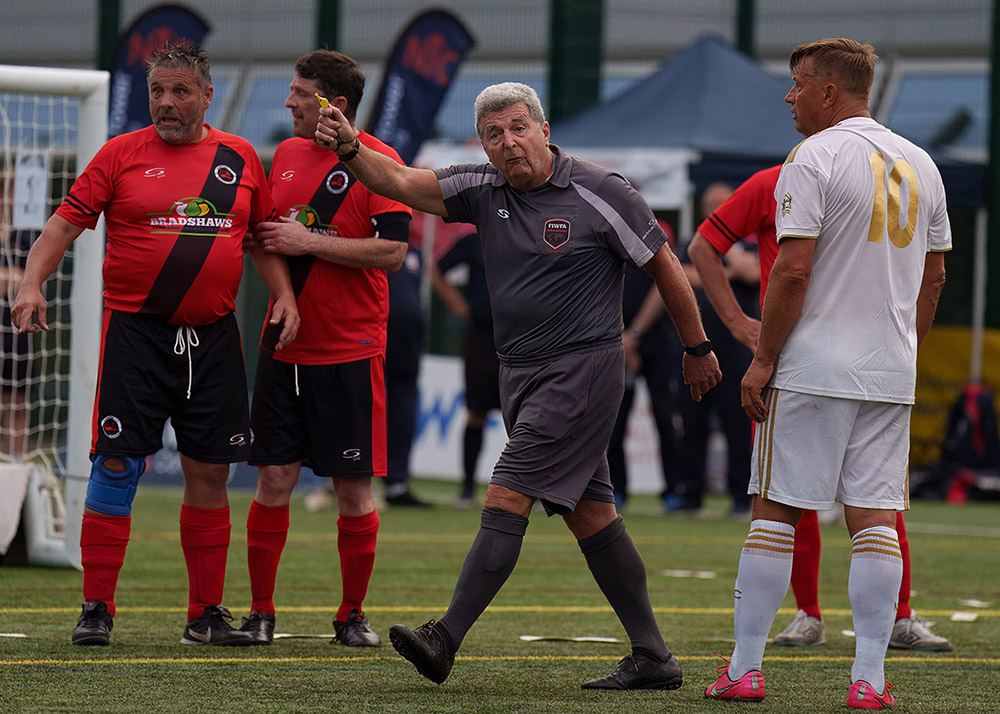
Walking football is governed by a handful of core principles shared across almost every rule set in the UK and internationally — whether you’re playing under FA, WFA, Walking Football Scotland, UEFA or FIWFA rules.
The essentials:
- Walking only — one foot must stay in contact with the ground at all times, no running or jogging
- Strictly non-contact — no tackling, pushing or shoulder charging
- Ball stays below head height — deliberate heading isn’t permitted
- No offside
- All free kicks are indirect
- Small-sided games — usually 5v5, 6v6 or 7v7
Different governing bodies (FA, WFA, Walking Football Scotland, UEFA and FIWFA) each have their own specific variations on disciplinary cards, goalkeeper rules and enforcement — particularly relevant if you’re playing competitively or in a specific league.
For the full breakdown of every rule set, disciplinary system, and a detailed comparison between FA, WFA, WFS, UEFA and FIWFA rules, read our complete Walking Football Rules Explained guide.

For Full Details Read Our Official Walking Football Rules Explained Guide
Section 3: Proven Health Benefits of Walking Football

| Benefit | What Research Shows (2025–2026) | Practical Impact |
|---|---|---|
| Cardiovascular health, aerobic capacity & metabolic markers | 2026 longitudinal study (32 active adults over 50, 9-month season) found reduced blood glucose and favourable lipid changes (especially in those 60+); aerobic capacity (VO₂ peak) was maintained, particularly in older players. Scoping reviews noted better blood pressure and cholesterol in several trials. | Lower risk of heart disease and type 2 diabetes; steady energy levels for daily life. |
| Balance, strength, flexibility & agility | Multiple 2025 reviews and a rural Australian pilot study reported gains in handgrip strength, lower-limb power, balance tests, agility and flexibility after 6–16 weeks. | Easier movement, fewer falls, better everyday function (e.g., climbing stairs, carrying shopping). |
| Body composition | Anthropometric measures (weight, BMI, waist size) stayed stable or improved with ≥120 min/week. Scoping reviews showed reductions in abdominal fat and body-fat percentage. | Healthier weight maintenance without strict dieting; visible toning and better-fitting clothes. |
| Mental wellbeing & reduced stress | Large 2025 UK survey (352 players) found 73.8% reported better mental wellbeing; validated scores were higher than national averages and stress levels lower. | Feeling calmer and more positive; improved sleep and mood. |
| Social connections & reduced loneliness | Same 2025 survey: 82.6% reported stronger social connections; 81.3% said they “hardly ever or never” felt lonely (vs 67.3% nationally). | New friendships, sense of belonging, less isolation – especially valuable after retirement. |
| Safety | Regular training and casual sessions show a low injury rate of 5.3 per 1,000 hours — below general recreational football. Competitive matches and tournaments carry higher risk. Full breakdown in our Safety & Injury Risk guide. 47% of players had chronic conditions yet reported few daily limitations and high enjoyment. | Suitable for almost everyone; gentle on joints and safe alongside medications. |
Key 2025-2026 Stats On Walking Football
Major 2025 Study (FA Walking Football Cup 2024 Survey)
Here are key 2025–2026 stats on walking football (also called walking soccer) from large player surveys, directly addressing high adherence and perceived benefits in social connections, fitness, and mental wellbeing.
A cross-sectional survey of 352 players (mean age 56, broad 33–81 range, 55% men / 44% women) at the 2024 England FA regional finals (published 2025 in Frontiers in Sports and Active Living):
Perceived benefits (since starting walking football):
• Social connections: 82.6% reported improvements.
• Physical fitness: 78.0% reported improvements.
• Mental wellbeing: 73.8% reported improvements.
• Adherence / continuation: 99.7% intended to keep playing over the next year (93.2% “definitely,” 6.5% “likely”). 86.7% had already played for >1 year.
• Fitness impact: 77.6% said their overall physical activity increased (37.9% “significantly”); 75% met/exceeded UK guidelines of ≥150 min/week moderate activity (vs. 63% national average for similar ages).
• Mental wellbeing metrics (validated scales): Higher than national averages; lower stress and loneliness; 87.6% rated their mental health as good/very good.

Supporting 2024/25 Data (WFA National Survey)
The Walking Football Association’s 2024/25 survey (2,125 responses from >9,000 subscribers) showed almost unanimously positive feedback. Players repeatedly highlighted life-changing social camaraderie, continued football enjoyment into older age, physical benefits (especially for those with joint issues/injuries), and mental wellbeing gains. Typical quotes: “made lots of new friends,” “camaraderie… great for mental well being,” and “still being able to compete at 79.”
Additional Context from Recent Reviews
Smaller intervention studies (2025–2026) consistently report session adherence of 81–97% (dropout <15%), with benefits strongest when sessions exceed ~120 min/week.
These figures come from real player surveys (not general fitness apps) and show walking football as a highly sticky, socially beneficial activity for the 45+/50+
Real-player highlights and testimonials
Don’t just take our word for it — here’s what real players are saying about their experience with walking football:
| Stan Harding | Atherstone Walking Football Club | I was a founder member of Atherstone Walking Football Club and been involved with them a number of years now plus i play despite just having knee replacement and have been diagnosed with a rare form of blood cancer. Walking football keeps me going despite all the setbacks |
| Colin | Thame Walking Football | Hi I’m Colin, I set up Thame Walking Football 30 months ago with A qualified ref Mike Dean ( would you believe) and it’s become quite a social group and boasts 20+ players including an excellent lady player! |
| Chris Tanner | Zenith Sports & Event Management | Working in football for most of my working life, I’ve witnessed the good and the bad, I’ve experienced the highs and the lows, I’ve seen the best and the worst. My weekly walking football fix is 30 people, men and women, with a genuine love for the game – football bliss does exist. |
| Markus Grunow | SSV Sueng | I am a walking football player from germany. I am 54 years old and have no critical disease, but lost nearly 40 kg and walking football helped me a lot to do so. Meanwhile the referees gave me some whistles for running and I am smiling as this never happened when I was on top of my weight. Football was always important in my life and I love to be able to play with my team (SSV Sueng) also against international teams from NL, GB, CZ, AT or PL. But the most important part is that the elderly, handicapped or not wealthy people can come together and have fun on and outside the pitch. |
| Titch Gray | I’ve just started playing walking football again after not kicking a ball for 5 years due to cancer, before that I used to play for the Welsh international team ,as captain, when it first started. | |
| Larry Hogan | Casual, in session venues | Over seventy, play casual, in house, sometimes mixed WF Fridays and Sundays. League over fifty WF once a month, Competition WF whenever we hold a tournament or are invited to one. Going to Spain next month for over fifty WF tournament over two days. |
| Barrie George | Various Clubs | I am an over 70s goalkeeper playing walking football for , Droylsden town, foundation 92, over 75s for Ribble valley invincibles Greater Manchester league team and 70s/75s EWFC gaining a few caps (10) |
Bottom line
Walking football delivers proven, wide-ranging benefits in a single enjoyable package. Aim for two 60-minute sessions per week (or more) to support your heart, muscles, mind, and social life while keeping injury risk minimal. Whether you’re 50 or 80, it’s an accessible way to stay active, connected, and healthy. Clubs are growing worldwide – why not give it a try?
For Full Details Please Read Our Health Benefits Of Walking Football For Seniors & Over 50s Guide
1. Main 2025 Peer-Reviewed Study (352-player FA Cup survey)
Title: Understanding the walking football population: A cross-sectional survey of players at The FA Walking Football Cup 2024
Authors: Price AG et al.
Journal: Frontiers in Sports and Active Living (2025)
open-access paper:
https://www.frontiersin.org/journals/sports-and-active-living/articles/10.3389/fspor.2025.1744101/full
PMC version (identical):
https://pmc.ncbi.nlm.nih.gov/articles/PMC12827653/
2. Walking Football Association (WFA) National Player & Club Survey 2024/25
Title: The state of the game – Player and club survey 2024/25 (2,125 responses)
Publisher: Walking Football Association (The WFA)
Full PDF (direct download):
https://thewfa.co.uk/wp-content/uploads/2025/09/WFA-Survey-Results-2024.pdf
Landing page with summary:
https://thewfa.co.uk/2024-player-and-club-survey-the-state-of-the-game/
3. Supporting 2025 Scoping Review (covers adherence data from multiple smaller intervention studies)
Title: A Scoping Review of Physical and Functional Outcomes in Walking Football: Current Evidence and Future Directions
Journal: International Journal of Environmental Research and Public Health (2025)
Full open-access paper:
https://www.mdpi.com/1660-4601/22/10/1533
For Full Details Please Read Our Health Benefits of Walking Football for Seniors & Over 50s Guide
Section 4: How To Start Playing Walking Football

What to Expect at Your First Walking Football Session
Walking football is football at walking pace – no running, no sliding tackles, just fun, friendly play on a smaller pitch with adapted rules. It’s designed for everyone who loves the game but wants to stay active without the intensity of regular matches. Whether you’re over 50, returning after years away, or simply want something sociable and low-impact, your first session is all about enjoyment and making new friends.
What happens when you arrive?
Most sessions start with a warm welcome from the organiser and a gentle 10-minute warm-up. You’ll then move into simple drills and small-sided games (usually 5v5 or 6v6). Expect plenty of laughs, encouragement from everyone, and regular water breaks. Sessions typically last 60–90 minutes and finish with a cool-down and chat. No previous experience is needed – many players turn up having not kicked a ball for decades.
What should you wear and bring?
- The right footwear for your surface — moulded or studded boots are typically required on 3G pitches, while indoor trainers suit astro turf and sports halls. Check with your session organiser what surface you’ll be playing on.
- Trainers or indoor football shoes – football boots are fine but not essential.
- Shin pads (highly recommended for peace of mind).
- A water bottle and a small towel.
That’s it! No expensive kit required.
Fitness level needed
Virtually none. Walking football was created for people who want to get moving again without high-impact stress on joints. You set your own pace – walk, stop for breath, or even stand and pass if you prefer. Many players start with very little fitness and quickly build stamina, balance and confidence.
Common fears – addressed
“I’m not fit enough.”
You are. The whole point is to get fitter in a supportive environment. Nobody is judging pace or skill.
“I might get injured.”
The walking-only rule dramatically reduces injury risk for regular training and casual sessions — the way most walking football is played. Most sessions are on soft grass or 3G pitches, with experienced organisers who prioritise safety. For the full, evidence-based picture on injury risk, see our Safety & Injury Risk guide.
“I won’t know anyone.”
You’re not alone! The vast majority of players arrive by themselves. The atmosphere is famously friendly and inclusive – within five minutes you’ll be chatting and passing the ball with new teammates.
Its been a bit like “lets get the band back together.”..Playing with Shelbourne WF in Dublin we have re connected with old friends we would never have reconnected with also making new friends ….an opportunity that would unlikely happen if we didn’t have Walking football…..Walking football is growing throughout the Island of Ireland and creates a fantastic opportunity to socialise with like minded people from different communities…long may it continue.
Tony Hatton , Shelbourne WF in Dublin
Ready to give it a go?
Find beginner-friendly or over-50s sessions near you using our directory. Filter by location, Walking Football club, session types and experience level – contact the organisers and book your first session in seconds.
Walking football isn’t just exercise. It’s friendship, laughter, and rediscovering the joy of the beautiful game – one step at a time. See you on the pitch!
For Full Details Please Read Our Walking Football for Absolute Beginners (Over 40, 50 & 60+) Guide
Section 5: How to Start Your Own Walking Football Club or Session

Section 5: How to Start Your Own Walking Football Club or Session
Starting your own walking football club or session is far simpler than most people imagine – and the rewards are huge. You don’t need a big budget, fancy facilities, or coaching qualifications. All it takes is enthusiasm, a safe space, and a desire to bring people together. In just a few weeks you can create a welcoming, low-impact football environment that improves physical health, lifts spirits, and tackles loneliness in your community. Here’s a practical, step-by-step guide to get you up and running.
1. Finding a venue & insurance
Begin with what’s already local and affordable. Approach parks, community centres, school fields, leisure centres or church halls that have a flat grass or 3G surface. Many offer free or low-cost slots for community health projects – simply explain the social and wellbeing benefits. Book an initial 60–90 minute slot once or twice a week.
Public liability insurance is essential but straightforward. Contact your national walking football body (if available) or a specialist sports insurer for a policy starting from as little as £80–150 per year for small groups. Many venues require proof of cover before you play – sort this early and you’re protected from day one.
2. Recruiting players
Spread the word that walking football is for everyone: over-50s, beginners, returners to the game, and anyone who wants gentle exercise with a social twist. Print simple flyers and posters highlighting “No running, no pressure, just fun and friendship.” Drop them at GP surgeries, libraries, cafes, retirement groups and local sports clubs.
Post in neighbourhood Facebook groups, Nextdoor, or WhatsApp community chats. Host a free taster session and invite people to bring a friend. Word-of-mouth is your best recruiter – one happy player often brings three more. Aim for 8–12 players to start; numbers grow quickly once the fun begins.
3. Basic equipment & funding options
Keep it minimal to prove how easy this is. You’ll need: a few size-5 footballs, coloured bibs (just two sets to begin), small goals or pop-up markers, and cones for drills. Total starter cost can be under £100. Borrow from local schools or clubs at first.
Funding is easier than you think. Apply for small community grants from local councils, national lottery schemes or health foundations (many prioritise over-50s activity). Charge a small weekly subs fee (£2–4) to cover pitch hire, or seek sponsorship from local businesses who love the positive PR. Crowdfunding pages also work well for kit and equipment.
4. Marketing tips
Be visible and consistent. Create a free Facebook page or group and post weekly photos and short videos of smiling players. Share success stories: “John lost 5 kg and made six new friends in his first month!” Partner with Age UK, local GPs or walking groups for cross-promotion. Local radio and newspapers adore feel-good health stories – send them a quick press release.
Keep sessions fun, friendly and inclusive. A warm welcome and post-match tea or chat will turn one-off visitors into regulars.
Ready to launch? Add your new session to our free global directory and connect with thousands of players worldwide. Submit your details here
Your community is waiting – one simple session can change lives. Get started today!
For Full Details Please Read Our How to Start Your Own Walking Football Club or Session Guide
Section 6: Women’s Walking Football, Beginners & Special Groups

Walking Football is transforming lives as a gentle yet engaging twist on the beautiful game. Played entirely at walking pace with straightforward rules—no running, no tackling, and the ball kept below head height—it emphasises fun, skill, and safety above all. This inclusive format continues to drive impressive growth, especially in women’s sessions, while creating welcoming spaces for mixed play, absolute beginners, and people of every background.
The Rise of Women’s Walking Football
Women’s participation has surged in recent years. Once largely male-dominated, the sport now boasts dedicated women-only groups, taster sessions, and England national teams competing from age 40 upwards. A major 2025 survey of players at the FA regional finals found women making up 44% of participants, with clubs across the UK reporting strong demand—many sessions attracting 50 or more players weekly and some operating waiting lists. This momentum has sparked a wave of new female-focused programmes. The outcome is a vibrant, supportive community where women of all ages rediscover fitness, gain confidence, and form lasting friendships in a relaxed, pressure-free environment.
Hi, I am the founder of Cambrian United Hot Steppers, nearly our five year anniversary with nearly 40 members ages ranging from 37-71 and what an amazing club we are so much fun, so many friendships made, members getting fit together sharing the same love & passion for the game
Jo Davies , Cam UTD Hot Steppers

Mixed Sessions Building Community
Mixed play adds another powerful dimension, bringing men and women of different ages and abilities together on the pitch. These inclusive games foster genuine community spirit, while organised competitions feature popular mixed 50+ and 60+ categories. International mixed fixtures have also taken place, proving the format delivers enjoyment and fairness for everyone.
Ideal for Absolute Beginners
Walking Football is perfectly designed for newcomers. No previous experience, special kit, or high fitness level is required—just comfortable trainers and a positive attitude. Sessions follow a gentle structure of warm-ups, skill drills, and small-sided games, allowing players to progress at their own pace. It is especially suitable for those returning after injury, managing long-term conditions, or stepping onto a pitch for the first time.
True Inclusivity at Its Heart
Above all, Walking Football champions inclusivity. It opens the door to anyone, regardless of age, mobility, background, or sporting history. With minimal injury risk, it delivers meaningful physical and mental health benefits while reducing loneliness and strengthening social connections. Whether you choose a women-only group, a mixed team, or a beginner-friendly session, Walking Football shows that the beautiful game really is for everyone—one enjoyable step at a time.
For Full Details Please Read Our Women’s Walking Football: Sessions, Leagues & Success Stories Guide
Section 7: Find Walking Football Near You – Global Directory
Discover the World’s Largest Walking Football Directory
WalkingFootball.com – the largest independent global directory since 2016

Welcome to walkingfootball.com search – the definitive online hub for walking football in the UK and beyond. With more than 2,400 carefully moderated listings, this directory is the most complete and trusted resource available, connecting players of all ages and abilities to sessions right on their doorstep.
Whether you’re searching by postcode, county or region, the powerful filter system instantly surfaces exactly what you’re looking for. Popular tags make browsing effortless: tap “over-60s” for relaxed, social sessions designed for older players; select “women” to find female-only or mixed groups; choose “beginners” if you’re new to the game and want a gentle introduction; or explore “tournaments” for one-day competitions, festivals and cup events across the country.
Every listing is verified by our moderation team, so you can be confident that contact details, times, venues and session formats are accurate and up to date. From friendly park walks in rural villages to floodlit urban leagues and national tournament circuits, the directory covers every flavour of walking football imaginable.
It’s more than just a list. It’s a thriving community map that helps clubs fill pitches, players find their tribe, and newcomers take their first confident steps into the sport. Many sessions are free or low-cost, and most welcome all abilities – no previous football experience required.
So whether you’re 55 or 85, male or female, a complete beginner or a seasoned walker-player, walkingfootball.com/sessions puts the perfect session just a click away. Bookmark it, share it, and become part of the fastest-growing grassroots sport in the country.
Start your search today below – your next walk-kick is waiting.
Section 8: Tournaments, Events & Community in 2026

Walking Football Tournaments, Events & Community from May 2026 onwards
Walking Football continues its strong growth in 2026 as an inclusive, low-impact sport for players aged 40+, promoting fitness, social connection and enjoyment at walking pace. From May onwards, the UK and international calendar mixes high-profile national cups with smaller regional festivals and club tournaments.
National Cups
The WFA National Cup Preliminary Rounds, for Men’s 50+, 60+, 65+, 70+, are now complete, with Second Round draws made and ready to play from 16th May. Full Details can be found here WFA National Cup 2026
The FA Walking Football Cup runs from May 2026 to September 2026 through to September 2026 June 2026. Full details can be found here 2026 FA Walking Football Cup
Smaller & Regional Tournaments
• North Ferriby Celebration Tournament – 17 May (10am–3pm), Versa Stadium: friendly matches across five pitches for 12 teams (£40 entry).
• Mallorca Walking Football Tournaments – mid-May (15–17 and 14–18 May options, English/Dutch rules).
• WFS Scottish Cup & Festival – 6 June, Glasgow Green Football Centre.
• Limerick Festival of Walking Football – two full days at University of Limerick with provincial teams (50+, 60+).
Major International Events
• Iberian International Cup – 24–25 September, Torrevieja, Spain: Men’s 50+/60+ and Women’s 40+/50+ in two formats (WFA 6v6 unlimited touch or SWF 7v7 three-touch). €45 per player (squad of 12); €120 club deposit. Includes pro referees, physio and live coverage.
• FIWFA European Nations Cup – November 2026 (proposed 2–6 Nov): national teams across six categories; £2,300 per team.
How to Get Involved
Search the free club directory at walkingfootball.com or contact your County FA for weekly sessions (beginners always welcome). For cups, affiliate via thewfa.co.uk and complete the online entry form. International events use dedicated sign-up links on spainwalkingfootball.com or fiwfa.org. Many smaller tournaments are listed on Facebook groups and local club pages.
From grassroots festivals to elite finals, there’s something for every walker.
Check thewfa.co.uk, fiwfa.org and walkingfootball.com for latest fixtures and registration.
Lace up and join the fun!

For Full Details Please Read Our Walking Football Tournaments & Events Guide
FAQ Section
Top 10 Most Asked Questions About walking football guide
1. What is walking football?
Walking football is a fun, low-impact version of the beautiful game designed for anyone who loves football but wants to play without the high-intensity running. Players must always keep one foot on the ground—no jogging or sprinting allowed—while enjoying the same skills, passing, and teamwork that make football special. Invented in 2011 by John Croot at Chesterfield FC, it has exploded in popularity across the UK and beyond, with thousands of clubs now offering sessions for people of all ages and abilities. It’s more than just sport—it’s a social lifeline that keeps you active, connected, and loving the game again.
2. What are the main rules of walking football
The core rules keep things safe, fair, and enjoyable while staying true to football’s spirit. You must walk at all times (one foot always in contact with the ground), and the game is strictly non-contact—no shoulder barges, slide tackles, or physical challenges. The ball must stay below head height (no heading allowed), free kicks are indirect, and games are usually small-sided (5v5, 6v6 or 7v7) on smaller pitches with shorter durations. Most sessions follow either FA or WFA laws, with a three-strike “sin bin” policy for repeated walking infringements. The emphasis is on skill, quick thinking, and fun rather than speed or aggression.
3. Who can play walking football
Pretty much anyone! While it was created with over-50s in mind, there are no strict age limits in many clubs—men over 50, women of any age, and even younger players in training sessions are welcome. Fitness levels vary hugely: complete beginners, former pros, and everyone in between play side-by-side. Many clubs run men’s, women’s, and mixed sessions, making it truly inclusive. If you can walk and enjoy a bit of friendly competition, you belong on the pitch.
4 – What are the health benefits of walking football?
Walking football delivers impressive physical and mental rewards backed by real research. It boosts cardiovascular health, helps manage blood pressure and blood sugar, improves balance, strength, mobility, and endurance, and supports healthy weight maintenance—all while being gentle on joints. On the mental side, players report better mood, reduced stress, lower feelings of loneliness, and stronger social connections through team banter and post-match chats. Many studies show it helps prevent chronic conditions, enhances quality of life, and keeps older adults active and independent longer. It’s exercise that actually feels like fun, not a chore.
5. Do I need to be fit or have football experience to play?
Absolutely not! That’s one of the biggest myths. You don’t need any prior experience—many players haven’t kicked a ball since school. Sessions are welcoming to all fitness levels, and you set your own pace. The walking-only rule means the game is accessible even if you’re returning after injury, illness, or years away from sport. Most clubs offer taster sessions so you can ease in gently. You’ll be amazed how quickly your fitness, skills, and confidence improve just by turning up and having a go.
6. What equipment or kit do I need for walking football?
Kit requirements are refreshingly simple and affordable. Wear the right footwear for your playing surface — moulded or studded boots are typically required on 3G pitches, while indoor trainers suit astro turf and sports halls — plus shorts or tracksuit bottoms and a breathable t-shirt. Shin pads are strongly recommended (and sometimes compulsory for matches) for extra protection. Many clubs provide training bibs, balls, and goals—so you often only need to bring yourself and a water bottle. Indoor sessions may need different footwear, but your local club will always advise what works best for their venue.
7. How do I get started with walking football?
Getting involved is easy and low-pressure. Search for your nearest club via the Walking Football Association (WFA) or England Football directories, or check local leisure centres and community groups. Most offer free or low-cost taster sessions so you can watch, chat with players, and try a mini-game without commitment. Simply register online, turn up in suitable kit, and you’ll be matched into a friendly team. Many clubs use apps or WhatsApp groups to confirm attendance and share social events afterwards—perfect for building friendships from day one.
8. Is walking football safe for beginners and older players?
For the majority of players enjoying regular training and casual sessions, yes — walking football carries a genuinely low injury risk, below general recreational football. Competitive matches and tournament play carry higher risk, similar to the pattern seen in most sports. Clubs follow strict safety guidelines, provide first aid cover at events, and encourage players to consult their GP if they have health concerns. For the full, evidence-based breakdown with citations, see our Safety & Injury Risk guide.
9. Can women play walking football?
Of course! Women are a huge and growing part of the walking football community. Many clubs run dedicated women’s sessions or mixed-gender games, and ladies’ teams compete in regional and national tournaments. The rules are the same for everyone, and the inclusive, supportive atmosphere makes it a brilliant way for women of all ages and abilities to stay active, make friends, and enjoy competitive (or purely social) football. Whether you’re completely new or a lifelong player, you’ll be made to feel welcome.
10. How long are walking football sessions and where do they take place?
A typical session lasts about one hour, including a warm-up, matches, and often a cool-down or social chat. Games are played on smaller indoor or outdoor pitches—artificial turf, 3G, sports halls, or grass—depending on the club and weather. Many venues have changing rooms and showers. Sessions run year-round (weather permitting), with no traditional “season” like 11-a-side football, so you can play consistently and fit it around your lifestyle. These FAQs position your website as the go-to resource while gently guiding visitors toward joining your sessions. They’re written to be warm, reassuring, and conversion-focused without feeling salesy. Drop them straight into a dedicated FAQ page or blog, and watch engagement grow! If you’d like them formatted in HTML, SEO-optimized meta descriptions, or more questions added, just let me know.
11. Which rules are used in most UK tournaments?
Most competitive tournaments and leagues in the UK use either WFA or FA rules (or a blend of both). Walking Football Scotland (WFS) rules apply in Scotland.
Official Walking Football Merch

- Walking Football LARGE print version ‘Vintage Player’, ‘Legends Never Run’ makes perfect gifts for vintage Walking Football players who work hard to keep their footwork in check & play to the Walking Football rules, as they stride to glory.

Last update on 2026-10-13 / Affiliate links / Images from Amazon Product Advertising API. Walking Football Limited is also an Amazon Associate and earns a commission from qualifying purchases
Recommended Reading
If you’ve enjoyed learning about walking football and want to dig a little deeper, there’s a growing collection of books covering everything from coaching advice and club setup to personal stories from players who’ve discovered the game later in life. Whether you’re looking for practical guidance to help you run better sessions, or simply want an inspiring read about the friendships and fitness the sport brings, these titles are a great place to start.
Want to learn more? Browse our recommended Walking Football books — guides, memoirs & coaching resources Browse Recommendations → As an Amazon Associate, Walking Football Limited earns from qualifying purchases. These are independently selected products from other sellers, not our own brand. Recommended Walking Football books Browse → As an Amazon Associate, Walking Football Limited earns from qualifying purchases. These are independently selected products from other sellers, not our own brand.Conclusion

Walking football has evolved into one of the most accessible, enjoyable, and beneficial sports available for adults over 40, 50, and 60+ in 2026. Whether you’re returning to the game after years away, looking to improve your fitness without high impact, seeking new friendships, or wanting to start a session in your local area, this modified version of football delivers real results.
The latest player surveys confirm what thousands of participants already feel: 82.6% report stronger social connections, 78% see improvements in physical fitness, and 73.8% experience better mental wellbeing. For the majority playing regular training and casual sessions, injury risk is genuinely low too — see our Safety & Injury Risk guide for the full, evidence-based picture. The clear rules (no running, ball below head height, minimal contact) combined with flexible formats make it suitable for complete beginners, women-only groups, mixed sessions, and experienced players alike.
With over 2,400 moderated listings in our global directory, finding a welcoming session near you — or adding your own club — has never been easier.
Walking football is far more than just “football at walking pace.” It is a proven way to stay active, build community, support long-term health, and rediscover the joy of the beautiful game — safely and sustainably.
Ready to take the next step?
- Browse 2,500+ walking football sessions worldwide and filter by location, women-only, beginners, over-60s, or tournaments
- Add your club or session for free and gain instant visibility to thousands of players. Simply register your free account here – Login and add your details within 2 minutes!
- Explore our in-depth guides below for deeper dives into rules, health benefits, starting a club, women’s walking football, and more
The game is growing rapidly in 2026 — don’t miss out. Your next session (and new friends) could be just a click away.
Last updated: July 2026
This Complete Guide draws on official rules from The FA, WFA, EUFA, FIWFA and Walking Football Scotland, the latest 2025–2026 research, and thousands of real player experiences from our global directory. WalkingFootball.com has been the largest independent walking football directory since 2016, with every listing manually moderated.
We update this guide regularly to reflect rule changes, new research and the evolving walking football community. Clubs and players are welcome to submit updates or corrections.
Learn more about WalkingFootball.com, our team and moderation standards.
Explore the Walking Football Hub
Dive deeper into walking football with our full series of guides:
- Official Walking Football Rules Explained (2026 Update)
- Is Walking Football Safe? Injury Risk Data (2026)
- Health Benefits of Walking Football for Seniors & Over 50s (2026)
- Walking Football for Absolute Beginners (Over 40, 50 & 60+)
- How to Start Your Own Walking Football Club or Session in 2026
- Women’s Walking Football: Sessions, Leagues & Success Stories 2026
- Walking Football Tournaments & Events Calendar 2026