
Table of Contents
Introduction
Walking football keeps the beautiful game accessible and safe for adults over 40, 50 and beyond. Clear, consistent rules are essential for fair, enjoyable, and injury-free play.
Please note: This page provides a clear overview of the main rules and Laws of the Game in 2026. It is not possible to include every single variation and detail from every organisation in one guide, or where league and tournament organisers use local tweaks.
Walking Football Rules: Quick Summary
If you’re new to walking football, here are the essential rules every player needs to know:
- No running — at least one foot must stay in contact with the ground at all times
- No physical contact — no tackling, shoulder charges, or pushing; players must go around an opponent
- Ball stays below head height — playing the ball above head height results in an indirect free kick to the opposition
- No heading — deliberate heading is not permitted
- No slide tackles — all tackles must be made while standing
- Small-sided games — usually played 5v5, 6v6 or 7v7 on a smaller pitch
- Indirect free kicks only — the defending team must stand at least 3 metres from the ball
These core principles are shared across most walking football organisations in the UK and beyond — though as you’ll see below, the FA, WFA, FIWFA, WFS and UEFA each have their own specific variations. Read on for the full breakdown of how each governing body’s rules differ.
Current Rule Sets in 2026
In the UK and internationally, the following key frameworks are in active use:
- England: The FA’s Laws of Walking Football (updated February 2025) and the Walking Football Association (WFA) Laws (updated April 2025). A joint consultation is currently underway to unify these two codes.
- Scotland: Walking Football Scotland (WFS) has its own well-established supplementary guidelines, built on IFAB principles.
- International / Competitive:
- UEFA Competitive Walking Football Laws (official standard for UEFA-affiliated tournaments and events such as the UEFA Walking Football Euro Cup).
- FIWFA (Federation of International Walking Football Associations) Laws of the Game — used for major international events such as the FIWFA World Nations Cup. FIWFA rules are closely aligned with WFA rules.
In 2026, Walking Football Scotland competitions enforce a compulsory 3-touch limit for outfield players (indirect free-kick if exceeded). UEFA competitive walking football uses a 5-touch cap (Law 12). FA and WFA core Laws of the Game have no touch limits (unlimited touches standard), though some WFA tournaments or recreational FA-affiliated clubs adopt 3-touch or 5-touch as local competition rules. Always check your specific league’s regulations.
This guide compares the most important differences across all these frameworks so you know exactly which rules apply to your sessions or competitions.
This detailed rules guide is part of our Complete Guide to Walking Football 2026 and links you directly to sessions that follow these official standards via our global directory.
If you require full comprehensive rules which you play to yourself, please visit:
- The FA Laws of Walking Football 2025
- WFA Laws of the Game 2025
- Walking Football Scotland Laws
- EUFA Laws Of The Game

Section 1: Core Principles of Walking Football
At its heart, walking football is guided by a simple but powerful spirit: safety first, fun and social focus, and accessibility for all abilities and ages.
Unlike traditional football, which is built around speed, power and athletic excellence, walking football was created specifically for adults over 40, 50 and 60+. The goal is to let people continue enjoying the beautiful game — or discover it for the first time — without the high injury risk that comes with running and heavy contact.
The key differences from traditional 11-a-side football are clear and deliberate:
Walking Football (2026) vs Traditional 11-a-side Football
| Aspect | Walking Football (2026) | Traditional 11-a-side Football |
|---|---|---|
| Speed / Movement | Walking only – one foot must stay on the ground | Full running and sprinting allowed |
| Contact | Strictly non-contact | Shoulder-to-shoulder contact and tackling allowed |
| Ball Height | Must stay below head height (no deliberate heading) | Heading is a key skill |
| Offside | No offside | Offside rule applies |
| Free Kicks | All indirect | Direct and indirect free kicks |
| Format | Small-sided (5v5 to 8v8) | 11 vs 11 on full-size pitch |
| Age Group | Mainly 40/50+ | All ages |
| Injury Risk | Very low (Price 2025 study: 7.1 per 1,000 hours) | Significantly higher |
These rules matter because they dramatically reduce injury risk while preserving the skill, teamwork, and joy that make football special. They allow older players, beginners, and those with health conditions to play safely and confidently.
For more on the benefits, see our guide to the Health Benefits of Walking Football for Seniors & Over 50s. New to the sport? Start with our Walking Football for Absolute Beginners.
Section 2: The Fundamental Rules Everyone Must Know
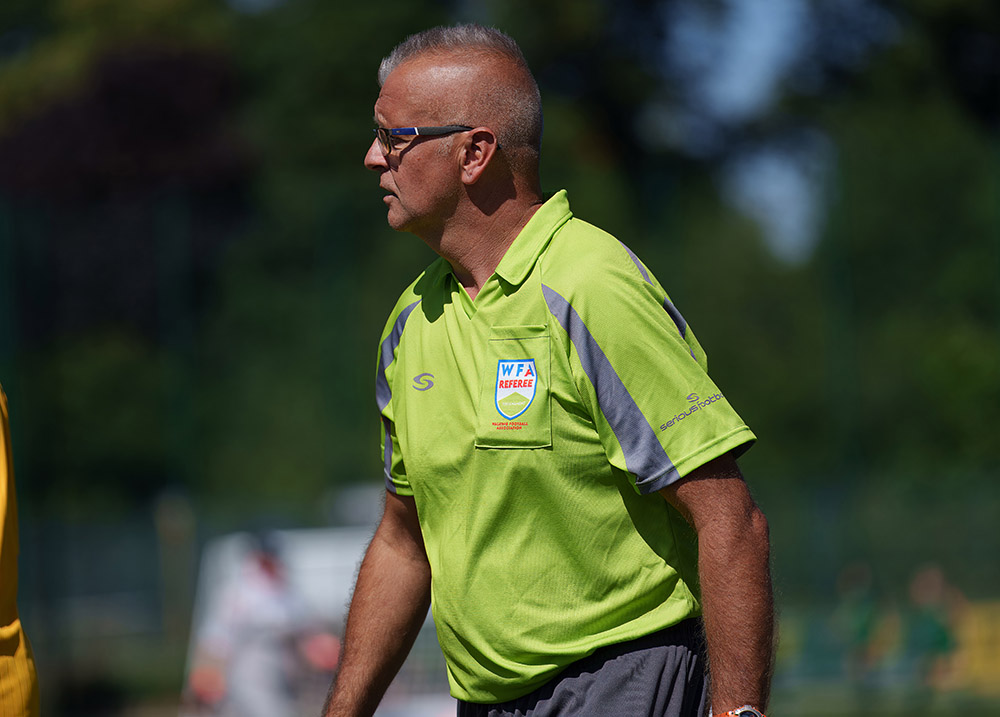
Walking football rules are designed to keep the game safe, fair, and enjoyable for adults over 40. In 2026, the four main governing bodies — The FA, the Walking Football Association (WFA), FIWFA and Walking Football Scotland (WFS) — all share the same core principles.
Here are the fundamental rules that every player should understand:
No Running (The Walking Rule)
One foot must remain in contact with the ground at all times. This is the defining rule of walking football. Referees have the final say. The FA, WFA and WFS have all issued clearer guidance in 2025/2026 on borderline movements such as jogging, skipping or sideways shuffling.
*Competition‑specific sanctions
In some competitions, repeated “not walking” offences lead to stronger sanctions rather than only indirect free‑kicks. For example, certain Scottish tournaments use a stepped system where multiple non‑walking infringements by the same team can result in a penalty kick, while some FA‑sanctioned and UEFA competitive formats use a team accumulation rule where a set number of running offences in a half can also lead to a penalty. Always check the specific competition rules for the exact thresholds and penalties in force.
Ball Height Restriction
The ball must not go above head height (typically around 1.83m or crossbar height, maximum 2m). This rule applies to all players, including goalkeepers. Recent updates from the FA (February 2025), WFA (April 2025), and WFS have clarified how deflections, saves and barriers are handled.
Physical Contact
Physical contact is strictly limited or prohibited. There are no tackles, shoulder charges, pushing, or crowding opponents against barriers. This rule is consistently enforced by all four organisations and is a major reason for the sport’s low injury rate.
In practice, this means no deliberate or forceful physical contact is allowed, and only minimal, incidental contact is tolerated at the referee’s discretion to keep the game safe and flowing in line with the formal Laws of the Game.
No Offside
Most formats of walking football do not use an offside rule. This keeps the game flowing and makes it more accessible for beginners and older players. See our Beginners Guide for more tips.
Free Kicks & Restarts
All free kicks are indirect. Opponents must usually retreat 3 metres. This applies to fouls, ball height violations, and running infringements across FA, WFA and WFS games.
Goalkeeper Rules
Goalkeepers can handle the ball in their area but are subject to restrictions on handling time, back-passes, and distribution. The FA, WFA and WFS have all provided updated clarifications in 2025/2026 to prevent time-wasting.
These core rules create a safe, inclusive environment while preserving the skill, teamwork, and enjoyment that make football special. Understanding them helps players feel confident and allows clubs to run consistent sessions.
The safety focus of these rules is strongly supported by evidence. The Price 2025 study, which analysed over 850 hours of play, recorded a very low injury rate of just 7.1 per 1,000 hours.
As explained in our Complete Guide to Walking Football 2026, these fundamental principles are shared by The FA, WFA, and Walking Football Scotland.
Section 3: FA vs WFA/FIWFA vs UEFA vs Walking Football Scotland – Side-by-Side Comparison (2025/26)
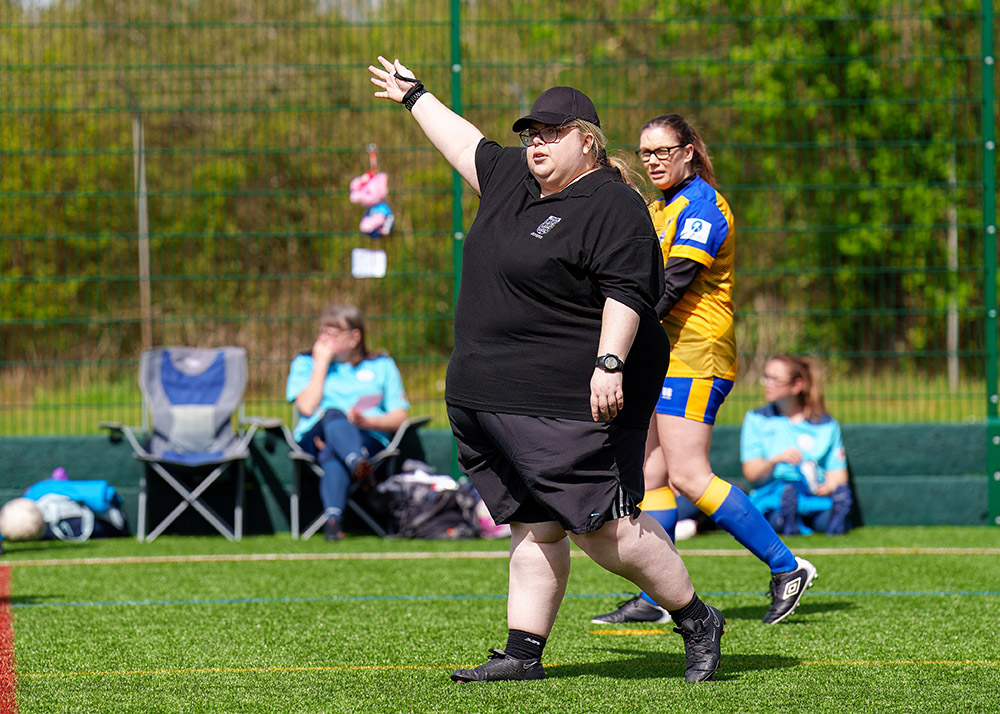
This is one of the most valuable sections for both players and club organisers. Below is a clear side-by-side comparison of the four main rule sets operating across the UK in 2026.
The FA (England), WFA (England), FIWFA, EUFA and Walking Football Scotland (WFS) all share the same core goal — making the game safe, inclusive, and enjoyable — but they have some differences in detail and enforcement.
“Non-Contact” can, in some instances be viewed as “no deliberate or forceful physical contact; only unavoidable light contact is tolerated at the referee’s discretion”
Here is the comparison:
| Rule | FA Rules (Feb 2025) | WFA Rules (Apr 2025) | Walking Football Scotland (WFS 2026) | UEFA Competitive Walking Football |
|---|---|---|---|---|
| No Running | One foot on ground at all times; team accumulation possible | Referee sole judge; clearer 2025 guidance | Strict – 3rd offence = penalty to opponents | One foot must remain in contact with ground at all times (Law 12) |
| Ball Height | Below head height | Below head height (clarified deflections/saves) | To crossbar height (no heading) | Below head height – deliberate heading = indirect FK (goalkeeper exception on saves) |
| Contact | Strictly non-contact | Strictly non-contact | Non-contact (no tackling, barging, 50/50s) | Non-contact version – charges, pushes, tackles etc. all indirect FK (Law 12) |
| Offside | No offside | No offside | No offside | No offside (Law 11) |
| Free Kicks | All indirect, 3m retreat | All indirect, 3m retreat | All indirect | All indirect only (Law 13) |
| Discipline / Cards | Blue card sin-bin + red | Blue card sin-bin + red | Blue card sin-bin (follows IFAB + WFS supplementary) | Yellow = 5-min sin bin (3 min in short tournaments) Red = send-off (Law 12) |
Advice for players and clubs: Always check with your local club which rules they follow. Many recreational sessions blend elements from all four organisations. Search our global directory to find sessions near you.
Note: The FA and WFA are currently in a unification consultation. Walking Football Scotland operates its own successful framework. Many clubs blend elements from all three for friendly play.

Section 4: Common Situations & Referee Decisions (Including UEFA 2026)
Knowing how referees apply the rules in real-game situations helps players and clubs avoid confusion and keep matches flowing safely. Below are the most common scenarios under FA, WFA, Walking Football Scotland (WFS), and the new UEFA Competitive Walking Football Laws.
Free Kicks, Goal Kicks, Corners & Restarts
- FA / WFA / WFS: All free kicks are indirect. Opponents must retreat 3 metres. Many sessions use kick-ins instead of throw-ins.
- UEFA Competitive: All free kicks and restarts are indirect only (Law 13). A 3-metre retreat is standard. Kick-ins are permitted where barriers are used.
In most competitive formats governed by The FA, WFA and UEFA, you cannot score directly from a kick‑off, indirect free‑kick, goal clearance or kick‑in, but you can score directly from a corner kick. Some Scottish and local recreational rules are stricter and may also ban direct goals from corners or from your own half, so always follow the competition’s own walking football regulations.
Walking Football Scotland competitions enforce a 3-touch limit for outfield players (an indirect free-kick is awarded if a player takes more than three consecutive touches), while UEFA Law 12 uses a 5-touch cap in competitive play. Many English recreational leagues also adopt a 3-touch rule as a local variation, but this is not universal—always check your league’s rules.
No Running / Walking Infringements
- FA / WFA: Referee’s discretion. First offences usually get a verbal warning. Persistent running can lead to a blue card sin-bin.
- WFS: Strict – 3rd offence by the same player = indirect free kick (penalty to opponents in some formats).
- UEFA: One foot must remain in contact with the ground at all times (Law 12). Any breach = indirect free kick. Repeated offences = yellow card + 5-min sin bin.

Ball Height Violations
- FA / WFA / WFS: Ball must stay below head height (≈1.83–2m). Deflections and goalkeeper saves are usually given leniency.
- UEFA: Deliberate heading = indirect free kick (except goalkeeper saves). Any ball above head height = indirect free kick to the opposing team.
UEFA competitive rules specify the limit as crossbar height (max 2m); if exceeded without a goalkeeper save, award an indirect free-kick from the spot (or 3m from penalty area line if in the area). Goalkeepers may play/rise above height only during an active save.
Physical Contact & Dangerous Play
- FA / WFA: Strictly non-contact. Indirect free kick + possible blue card.
- Walking Football Scotland (WFS): Strictly non-contact. Indirect free kick + possible yellow card.
- UEFA: Any charge, push, trip, shoulder barge or tackle = indirect free kick (Law 12). Serious or reckless contact = yellow/red card.
Penalty Area & Goalkeeper Rules
- FA / WFA / WFS: Only the goalkeeper may enter their penalty area. Goalkeepers may handle the ball inside the area but have restrictions on distribution and time-wasting.
- UEFA Competitive: Played 6v6 with goalkeepers. Only the goalkeeper is allowed in the penalty area (semi-circle, 6m radius – Law 1). Attackers entering = indirect free kick. Goalkeepers follow specific handling and distribution rules (Law 16 – Goal Clearance).
Real-World Referee Examples (2026)
- A player takes two jogging steps → Verbal warning (FA/WFA) or indirect FK on 3rd offence (WFS/UEFA).
- Ball rebounds off a barrier above head height → Indirect free kick to opponents.
- Player pushes an opponent while challenging for the ball → Indirect FK + possible yellow/blue card (UEFA = yellow + sin-bin).
- Goalkeeper holds the ball for more than 6 seconds → Indirect free kick to the opposition.
- Deliberate handball → Indirect free kick + caution (yellow/blue card).
Tip for clubs: UEFA rules are mandatory for any UEFA-affiliated competitions. For friendly/recreational play, most UK clubs still blend FA/WFA/WFS elements. Always confirm the rule set before a tournament.
Sources: FA Laws (Feb 2025), WFA Laws (Apr 2025), WFS Supplementary Rules, UEFA Competitive Walking Football Laws of the Game 2026.
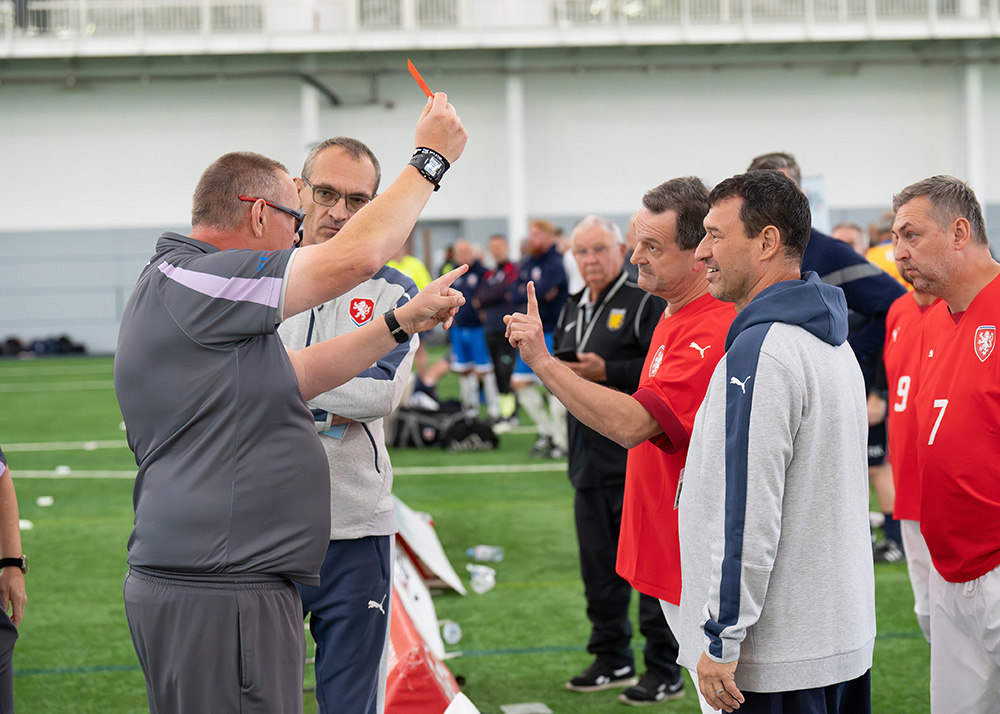
Section 5: Disciplinary Actions & Cards Explained (FA / WFA / WFS / UEFA 2026)
Walking football uses a modified disciplinary system to keep the game safe, fun and flowing. Different organisations use different coloured cards for temporary dismissals.
Disciplinary Actions & Cards (2026)
🟦 BLUE CARD (FA / WFA)
Temporary sin-bin
Duration: Usually 5 minutes or 10% of match time (check competition rules).
Player must leave the pitch and remain in the sin-bin area. Team plays short-handed.
🟨 YELLOW CARD (WFS & UEFA)
Temporary sin-bin
WFS: Standard IFAB timing
UEFA: 5 minutes (3 minutes in short tournaments)
Player must leave the pitch and remain in the sin-bin area.
🟥 RED CARD (All Organisations)
Permanent send-off
Player is excluded for the rest of the match. Team continues short-handed.
Common Offences & Typical Sanctions
| Offence | Typical Sanction (FA/WFA) | Typical Sanction (WFS) | Typical Sanction (UEFA) |
|---|---|---|---|
| Running / Not walking | Warning → Blue card on repeat | Warning → Yellow card on repeat | Indirect FK + Yellow card on repeat |
| Ball above head height (deliberate) | Indirect FK + possible Blue card | Indirect FK + possible Yellow card | Indirect FK + Yellow card |
| Physical contact / pushing / tackling | Indirect FK + Blue card | Indirect FK + Yellow card | Indirect FK + Yellow / Red card |
| Dissent or unsporting behaviour | Blue card | Yellow card | Yellow card |
| Serious foul play / violent conduct | Red card | Red card | Red card |
| Denying obvious goal-scoring opportunity | Blue or Red card | Yellow or Red card | Yellow or Red card |
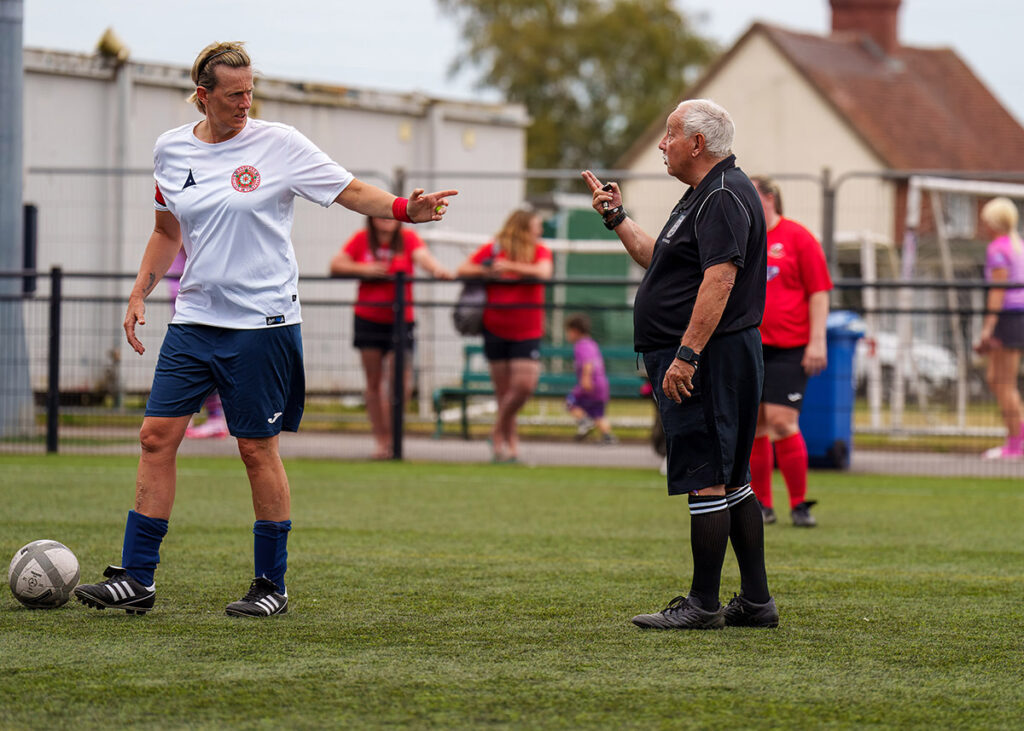
Safety & Injury Reduction (Price 2025 Study)
The landmark Price 2025 study (published in Frontiers in Sports and Active Living) analysed real-world injury data across hundreds of hours of walking football. It recorded a low overall injury incidence of 7.1 injuries per 1,000 hours in community settings — highlighting how strict enforcement of non-contact rules, walking-only discipline, and proper card sanctions contribute to making walking football one of the safest team sports for adults over 50.
Clear disciplinary systems (blue/yellow cards + sin-bins) play a key role in maintaining this excellent safety record.
Key Differences Summary
- FA & WFA use the Blue card as the main tool for temporary dismissals – this is the most common system in England.
- Walking Football Scotland (WFS) uses the Yellow card (standard IFAB style).
- UEFA Competitive uses the traditional Yellow card with timed suspensions. This is mandatory for UEFA-affiliated tournaments.
- A second Blue or Yellow card usually results in a Red card and permanent dismissal.
Best practice for clubs & referees: Clearly state the card system and sin-bin duration in the pre-match briefing. Many mixed events now use a “Blue/Yellow = sin-bin” hybrid approach.
Match Officials (Referees and Assistants)
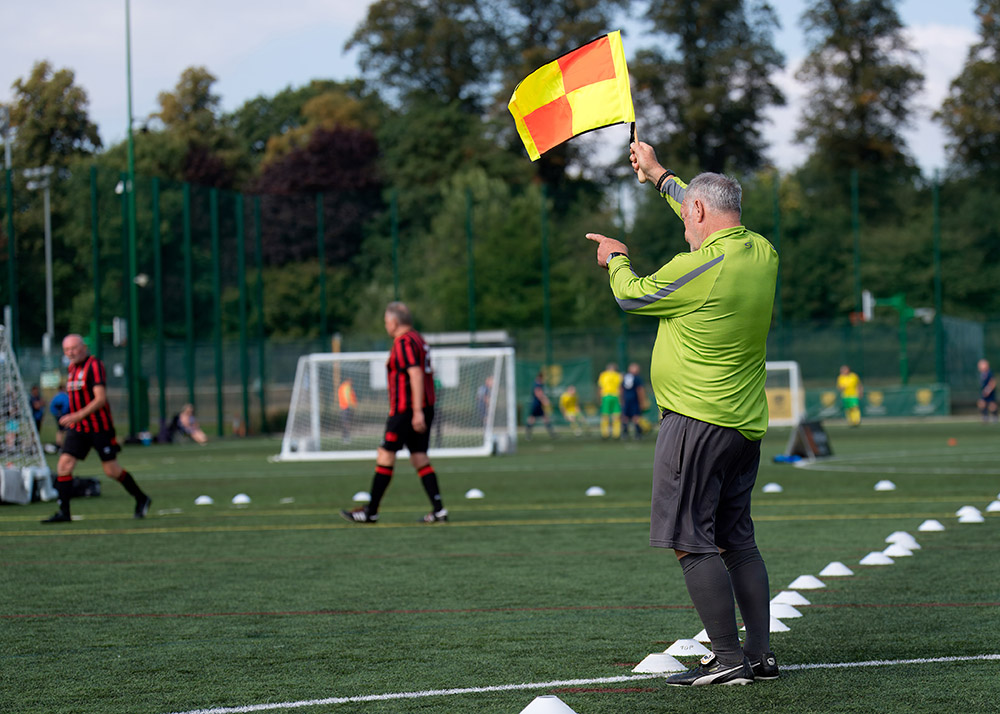
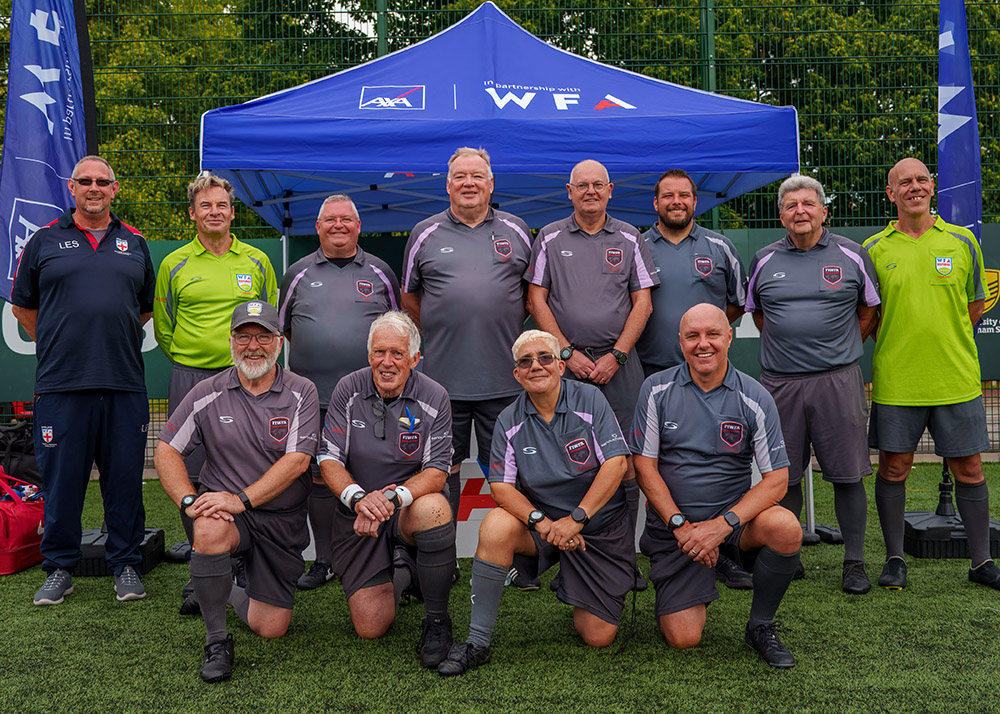
Most walking football matches are controlled by a single referee, but larger tournaments and national or international events sometimes appoint a full team of walking match officials. This can include neutral assistant referees (often acting as “linespeople”) to help judge ball out of play, goal‑area infringements and walking offences near the touchline, and, in some competitions, a separate timekeeper. The use of assistant referees is not built into the core Laws of the Game for FA, WFA, FIWFA, UEFA or Walking Football Scotland; instead, it is set out in each competition’s regulations, so players and coaches should always check how many officials will be used at their event.
Sources: FA Walking Football Laws (Feb 2025), WFA Rules (Apr 2025), Walking Football Scotland Supplementary Laws 2026, UEFA Competitive Walking Football Laws of the Game, Price et al. (2025) Frontiers in Sports and Active Living.
FAQ
What is the main “no running” rule?
One foot must remain in contact with the ground at all times. Referees have the final say. FA/WFA usually start with a warning. WFS and UEFA are stricter — repeated offences lead to an indirect free kick and a card (blue or yellow).
How high can the ball go? What counts as head height?
The ball must stay below head height (typically ~1.83 m or crossbar height). Deliberate heading is not allowed. UEFA gives an indirect free kick for deliberate heading (except goalkeeper saves). Deflections and saves usually get leniency.
What are the main differences between FA, WFA/FIWFA, WFS and UEFA rules?
Yes — see the big comparison table in Section 3. The biggest differences are in card colours (Blue vs Yellow), strictness on running, and goalkeeper/penalty area rules. UEFA is the official standard for competitive international events.
Do walking football matches use goalkeepers?
Yes in official UEFA Competitive matches (including the UEFA Walking Football Euro Cup). Games are 6v6 with one goalkeeper per team. Only the goalkeeper may enter the penalty area (semi-circle, 6m radius).
Some recreational and national formats in countries like Germany use a no-goalkeeper version with a no-entry goal zone instead. Always check the specific rules for your session or tournament.
What cards are used and what do they mean?
Blue card (FA / WFA) → Temporary sin-bin
Yellow card (WFS & UEFA) → Temporary sin-bin
– WFS follows standard IFAB timing
– UEFA = 5 minutes (3 minutes in short tournaments)
Red card (all organisations) → Permanent send-off
Is walking football very strict on contact?
Yes — it is strictly non-contact or minimal contact across all rule sets. Any pushing, tackling, barging or shoulder charging results in an indirect free kick and usually a card. In practice, this means no deliberate or forceful physical contact is allowed, and only minimal, incidental contact is tolerated at the referee’s discretion to keep the game safe and flowing in line with the formal Laws of the Game.
Which rules should my club use in 2026?
Recreational / grassroots → FA or WFA (or a blend)
Scotland → Walking Football Scotland guidelines
UEFA-affiliated tournaments → UEFA Competitive Laws
Choose what best suits your players and clearly communicate the rules.
Browse sessions in our global directory.
Have the rules changed for 2025/2026?
Yes. The FA, WFA, and Walking Football Scotland all released updates in 2025 with clearer guidance on the walking rule, ball height, and goalkeeper procedures.
Where can I see the full official rules from all four organisations?
Where can I find sessions that follow these rules?
Search our global directory and look for clubs that state which rules they follow.
Official Walking Football Merch

- Perfect as one of your Walking Football gifts for both men and women, or bag it yourself, if you think Walking Football is more fun with less run! Where the speed of your feet matters less than the size of your smile. That’s why Walking Football rules!

Last update on 2026-10-08 / Affiliate links / Images from Amazon Product Advertising API. Walking Football Limited is also an Amazon Associate and earns a commission from qualifying purchases
Conclusion
Walking football in 2026 has clear, well-established rules that successfully balance enjoyment, safety, and fairness. While the FA, WFA, and Walking Football Scotland remain the main frameworks in the UK, UEFA Competitive Walking Football Laws and FIWFA now provide the official international standard for serious competitions.
The core principles stay the same across all versions:
- Walk only (one foot on the ground)
- Ball below head height
- Strictly non-contact
- Indirect free kicks only
- Strong emphasis on player safety
The Price 2025 study confirms these rules work — delivering one of the lowest injury rates of any team sport for adults over 50.
Final Tip: Always confirm which rule set your session or tournament is using before you play. When in doubt, ask the organiser or referee — clear communication keeps the game safe and fun for everyone.
Sources & Further Reading:
- UEFA Competitive Walking Football Laws of the Game (2026)
- FA Walking Football Laws (Feb 2025)
- WFA Rules (Apr 2025)
- Walking Football Scotland Supplementary Laws (2026)
- Price et al. (2025) Frontiers in Sports and Active Living
Ready to put the rules into practice?
- Browse sessions and clubs that follow official walking football rules in our global directory (2,451+ listings)
- Filter by tags or location to find FA/WFA-style play near you
- Add or update your club’s listing and specify your ruleset – free
- Read more: Walking Football for Beginners | Health Benefits | How to Start a Club | Complete Guide 2026
Last updated: July 2026
This guide references the latest official documents from The FA (February 2025), WFA (April 2025), UEFA Competitive Walking Football and Walking Football Scotland. Rules continue to evolve with the ongoing FA–WFA unification consultation. If you are a club and would like to submit rule clarifications or event details, please contact us.
WalkingFootball.com has been the largest independent global directory since 2016. Learn more about us.
Explore the Walking Football Hub
Dive deeper into walking football with our full series of guides:
- Complete Guide to Walking Football 2026
- Official Walking Football Rules Explained (2026 Update)
- Health Benefits of Walking Football for Seniors & Over 50s (2026)
- Walking Football for Absolute Beginners (Over 40, 50 & 60+)
- How to Start Your Own Walking Football Club or Session in 2026
- Women’s Walking Football: Sessions, Leagues & Success Stories 2026
- Walking Football Tournaments & Events Calendar 2026