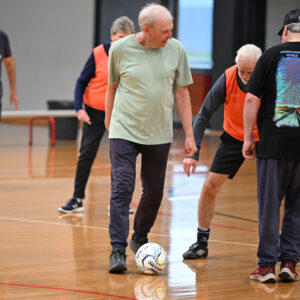
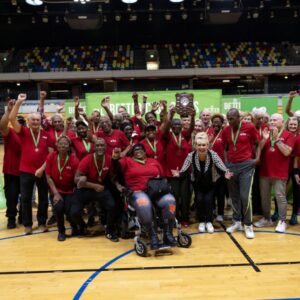
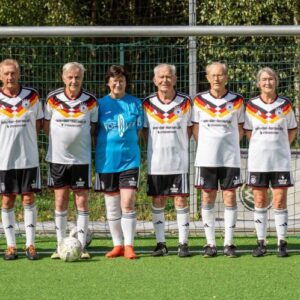
Michael Rätsch’s soccer career began unusually late: He didn’t join his first club until he was 24, but 55 years later, he’s still playing. At Hertha BSC, he founded a walking soccer team, which he still manages and plays for to this day. Prior to that, he had already spearheaded Berlin’s first competitive league for this variation of soccer at FV Wannsee. After playing for many years for Hertha BSC’s over-60 and over-70 teams in the BFV’s senior league and celebrating numerous championships and cup victories, Rätsch retired from regular soccer two years ago. In this BFV interview, he explains, among other things, why he took up the sport again for the Over-80 World Cup and how the tournament unfolded.
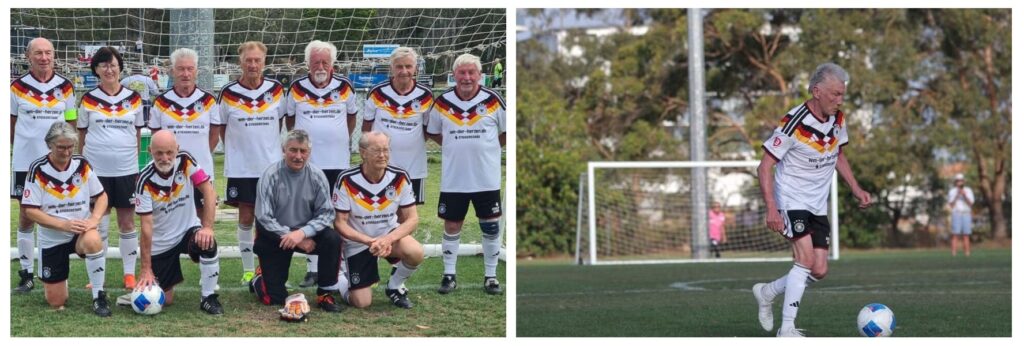
Mr. Rätsch, at the age of 79, you became soccer world champions in Australia this past October. How do you feel about this title?
It was overwhelming because no one on our team expected that we’d actually be able to win the title. We were surprised by our own performance, and now we’re the first-ever Over-80 World Champions. That’s something that will last a lifetime.
It was the first international tournament in this age group, and her team wasn’t put together until shortly before the World Cup. What’s the nomination process like? Do players in the over-80s category ever get a call from the national team coach?
In early 2026, word got around in Berlin that several national teams in the over-age categories were looking for players. I’d actually called it quits with regular soccer at the senior level two years earlier and had most recently been active exclusively in walking soccer, where I play for Hertha BSC and volunteer as the team manager. That’s why I wasn’t interested in the national teams at first. In mid-April, my Hertha teammate “Schulle”—Karl-Heinz Schulze—told me he had signed up for the over-80s national team, and he recommended that I join as well. He put me in touch with Günter Christmann, who had already started the over-70 and over-75 teams and contacted me with a schedule leading up to the World Cup. So I drove to Windeck in North Rhine-Westphalia for my first training session in May. But that still didn’t convince me.
Why not?
I was initially undecided for several reasons: First, because I had already stopped playing regular soccer. Second, there was the long journey. Seven hours to Doha, then 14 hours to Brisbane, and then the bus transfers—a total of 24 hours. The financial costs for flights, lodging, and meals naturally played a role as well—especially since I’d already been on a longer camping trip in Australia and was therefore wondering whether the tournament would be worth the effort. Furthermore, at the first practice session in Windeck, there was only one player over 80 years old, and the World Cup allowed for a maximum of five younger players.
In the end, you overcame your doubts…
On July 10, a friendly match between the national team and a Berlin over-80s selection took place in Berlin-Mahlsdorf, which we won convincingly 3–1. That’s when I made my decision in favor of the national team. We gathered important insights and gradually put our team together. By the time of the final training camp, we had assembled a roster of nine men and two women. The only one missing was a goalkeeper, who, however, showed up at Frankfurt Airport at the very last minute. And so, on October 6, we were able to set off at full strength, with five Berliners on the team.
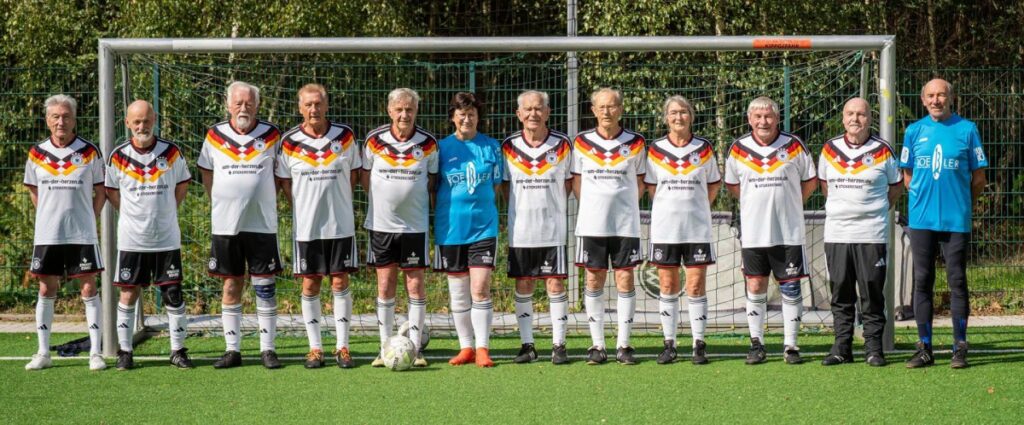
New to the game? Find Walking Football for beginners in Berlin
What happened next in Australia?
We had a few days to acclimate in Brisbane. We took a city tour and went on a few excursions before the first two games took place on October 12: against Japan in the morning and against Australia in the afternoon. In Japan, there’s a lot of recreational sports for older adults, so we expected a fit opponent to kick things off. They were very lively, and we fell behind 0–1, which is why I personally started to panic a bit. Leo Weichselbaum tied the game just before halftime, and when the Japanese were desperate for the win, I scored the game-winning goal on a counterattack to make it 2–1. In the afternoon match against the very physical Australians, we managed to keep the game even and ended in a draw. We were satisfied with four points on the first day.
But there was no time to rest—we were back at it the very next day.
The next day, we faced the two U.S. teams, California and United. Unfortunately, I suffered an early-stage strain during the first game against United. We had two physical therapists with us who immediately applied ice and put on a compression bandage, so I was still able to limp my way through the game, and we won 1–0. Against California that same evening, I was able to play somewhat normally again; however, despite what felt like 70 percent possession, we lost due to a fluke goal. The physical strain was already intense. During the tournament, temperatures hovered around 30 degrees, and by the time the final was over, everyone except our goalkeeper had sustained injuries.
Still, you managed to come out on top.
Seven points were enough to face the fourth-place Japanese team in the semifinals, whom we easily defeated 3–1. In the final, we faced United. The fact that we were able to win the final 2–0 was also thanks to our center forward, Karl-Heinz Schulze. He scored or somehow managed to put the ball in the net from impossible situations. He’s a phenomenon—I don’t know how he always manages to get the ball in—but in any case, two went in, and we were world champions.
What stands out from this tournament?
Afterward, all the teams were invited to a winery near Brisbane, where the medals and trophies were presented. But what’s far more important is that it shows soccer knows no age limits. Anyone can participate, whether young or old, and if you have that passion for the sport, you’ll keep it well into old age. Our oldest player was 86—just four years shy of 90. You can’t praise it highly enough how fit he and everyone else still are. That’s why I encourage everyone—men and women alike—to feel free to join a soccer or walking soccer team even in their later years.
And what’s next for you after the World Cup?
My heart really belongs to walking soccer, but another gathering of the national teams is already scheduled for the near future, and there are supposed to be several international matches and even a European Championship. The next World Cup will take place in Dallas, Texas, and if I stay as fit as I am now, I’d even participate again…
Find Walking Football clubs in Germany near you
Related Posts
Women’s Walking Soccer group kicking it in Denton Texas

Stratford Town FC to host Masters Walking Football World Cup in 2027
Newmarket resident’s team first to win North American walking soccer championship
Teams from England help celebrate Toronto’s Parkinson’s United Walking Soccer Festival at Cherry Beach
WFA National Cup 2026 Day 1 – 318 Photo Galleries Now Live

Walking Football Association National Cup Winners Announced
Author: The Walking Football
You create the memories; we help you relive them forever!