Walking Football in England is getting one set of rules. On 13 November 2026, The FA and the Walking Football Association (WFA) announced a unified set of Laws of the Game for Walking Football, and the new Walking Football rules come into effect in January 2027.
For years, players have found that the rules can change depending on where you play, who is organising the tournament and which body runs the competition. The new unified Laws are designed to end that, giving everyone in the game the same framework to follow.
Table of Contents
New Walking Football Rules: Key Facts
- What: one unified set of Walking Football Laws of the Game for England
- Who: The FA, the governing body for Walking Football in England, and the WFA, a National Delivery Partner
- When: the new Laws come into effect in January 2027
- Why: 98% of people in a national survey wanted one set of Laws
- Biggest change: not walking and physical contact offences now share one count, with a blue card at three and a team penalty at six
- Referees: a new Referee Development Panel is running online webinars before the Laws start
- Reviews: the Laws will be reviewed every year
Why Are The Walking Football Rules Changing?
The new Laws follow a partnership between The FA and the WFA and a period of collaboration, consultation and practical testing. A national survey in early 2026 showed just how much support there was for change: 98% of respondents agreed that a unified set of Laws was needed, and 93% recognised that some compromise would be required to get there.
The aim is simple. Players, coaches, referees, competition organisers and clubs will all work from one common set of Laws, with more consistency across England and player health and safety at the heart of the game.
The New Walking Football Rules Explained
The FA has published a Summary of Changes for January 2027. Here are the main changes in plain English, Law by Law.
Not walking and physical contact now count together (Law 18)
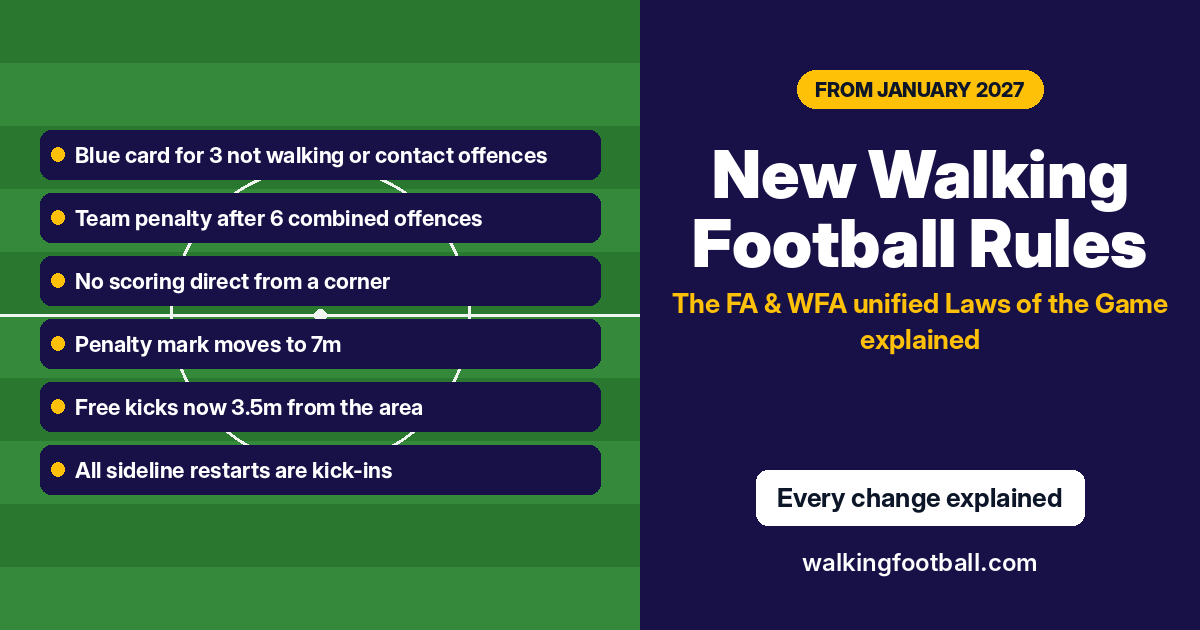
This is the biggest change for most players. Not walking and physical contact offences are now combined into one count, both for each player and for the whole team. A player who commits three of these offences in a match is shown a blue card. On the sixth combined offence by a team, the opposition is awarded a penalty kick, and the team count goes back to zero. The team count resets at half-time, except in matches shorter than 20 minutes. The aim is to cut these offences down and keep every player safe.
Blue card suspensions set by match length (Law 12)
A blue card means a temporary timed suspension, and its length now depends on how long the match is: 3 minutes for matches under 20 minutes, 4 minutes for matches of 20 to 29 minutes, and 5 minutes for matches of 30 minutes or more. Any time left at half-time is served at the start of the second half (and the same applies in extra time), and a player still serving a suspension when the match ends can take part in a penalty shoot-out.
No more scoring direct from a corner (Law 17)
A goal can no longer be scored directly from a corner kick. Another player has to deliberately play or touch the ball first. The same clarification has been added for the kick-off (Law 8).
Height restriction and goalkeepers (Law 9)
A height restriction must still apply, set no lower than the crossbar and no higher than 2 metres, and the indirect free kick is now taken from where the ball last touched the player. If a goalkeeper sends the ball over the height limit with a save or block, the other team gets a kick-in level with where it happened. If a goalkeeper in control of the ball breaks the height limit inside the penalty area, the indirect free kick is taken 3.5m from the penalty area line.
Free kicks moved to 3.5m (Laws 13 and 16)
Free kicks to the attacking team near the penalty area are now taken 3.5m from the penalty area line, up from 3m. The same distance applies when a goalkeeper touches the ball twice from a goal clearance. The extra half metre means a defensive wall can stand 3m away without stepping into the penalty area.
Penalty kicks (Laws 1 and 14)
The penalty mark moves from 6.5m to 7m from the goal, so the taker does not end up inside the penalty area. Penalty takers must also not feint to kick the ball once they have completed their approach.
Kick-ins only, and goal clearances must be kicked (Laws 15 and 16)
Roll-ins have been removed, so every sideline restart is a kick-in. Goal clearances must now be kicked, with all references to throwing removed.
Dropped balls and equipment (Laws 8 and 4)
Dropped ball and equipment rules have been brought into line with other formats of the game. Inside the penalty area, the ball is dropped for the defending goalkeeper. Elsewhere, it is dropped for the team that would have kept or won possession, with every other player at least 4m away. For equipment, accessories must not be dangerous, and head covers have to meet set conditions, such as matching the shirt colour.
For the exact wording of every change, read the Summary of Changes and the full Walking Football Laws of the Game on England Football.
What The New Laws Mean For Players And Clubs
If you play in FA competitions, these are the Laws you will be playing under from January 2027. The FA will use them in all of its Walking Football competitions and recommends that every Walking Football organiser in England adopts them too.
For clubs, that means a good time to brief players, update any house rules and make sure your session leaders know what is changing. For players who enjoy tournaments, it should mean fewer surprises, as the same Laws apply from one event to the next. If you are unsure how the changes affect your club, your County FA is the place to ask.
Whether you started on the school field, played Sunday league or found the game later in life, Walking Football is the next chapter. Our Evolution of a Walking Football Player t-shirt celebrates exactly that journey.

- The iconic March of Progress, Walking Football style. From a kickabout as a kid to flying down the wing, then hands on knees & out of breath – every footballer knows this journey. Now it can end with Walking Football, new friends & a trophy raised high.

Last update on 2026-11-09 / Affiliate links / Images from Amazon Product Advertising API. Walking Football Limited is also an Amazon Associate and earns a commission from qualifying purchases
Support For Walking Football Referees
Referees are getting help to prepare. A new Referee Development Panel has been set up, and its first job is a series of online webinars to help referees understand and apply the new Laws before they come into effect.
England Football Learning also runs a free online course, The Guide to the Laws of Walking Football, with an updated version due in early 2027. If you would like to become a recognised FA Walking Football referee, contact your County FA for details of a course near you. You can find more on the England Football Rules and Refereeing page.
What Happens Next?
The FA and the WFA will review the Laws every year to make sure they stay relevant as Walking Football keeps growing. Between now and January, expect clubs, leagues and tournament organisers to start preparing for the switch.
New Laws or not, one thing never changes: Walking Football players are not old, they are still playing. Our newest design says it loud and proud.

- I’m not old, I play Walking Football! A vintage club crest for the man who refuses to act his age and still loves the game, with a distressed shield, ribbon and stars. A cheeky old man joke for the clubhouse, match-day socials and family days out.
Last update on 2026-11-13 / Affiliate links / Images from Amazon Product Advertising API. Walking Football Limited is also an Amazon Associate and earns a commission from qualifying purchases
New Walking Football Rules FAQs
When do the new Walking Football rules start?
The new unified Laws of the Game for Walking Football come into effect in January 2027.
Do the new Laws apply to my club?
The FA will use the new Laws in all of its Walking Football competitions and recommends that every Walking Football organiser in England adopts them. If you are unsure, contact your County FA for advice.
Where can I read the full Walking Football Laws of the Game?
The full Laws, the Summary of Changes and a Laws FAQ are all on the England Football Rules and Refereeing page.
Why have the Walking Football rules changed?
Different organisations and competitions have used different rules. A national survey in early 2026 found 98% of respondents wanted one unified set of Laws, giving everyone the same framework across England, with player health and safety a priority.
How can referees learn the new Laws?
A new Referee Development Panel is running online webinars before the Laws take effect, and England Football Learning’s free online course, The Guide to the Laws of Walking Football, is being updated for early 2027.
What is a blue card in Walking Football?
A blue card is a temporary timed suspension. From January 2027 it lasts 3, 4 or 5 minutes depending on the match length, and a player gets one for three combined not walking or physical contact offences.
Can you score directly from a corner in Walking Football?
No. Under the new Laws, a goal cannot be scored directly from a corner. Another player must deliberately play or touch the ball first.
What is the height limit in Walking Football?
Competitions set a height restriction that cannot be lower than the crossbar or higher than 2 metres. Going over it gives the other team an indirect free kick.
Where can I find a Walking Football club near me?
Search our Walking Football clubs directory to find sessions near you.
Looking for Walking Football gifts for a teammate, Dad or Grandad? Browse our full range of Walking Football t-shirts, hoodies and gifts in the Walking Football shop.

Author: The Walking Football
You create the memories; we help you relive them forever!